
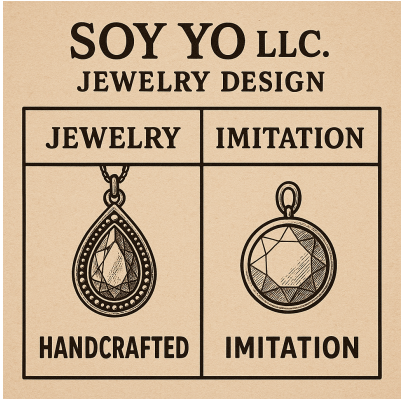
How to Identify an Authentic Handmade Jewel (and Avoid Imitations)
1. Observe the details and finishes
Handmade jewelry usually has small irregularities that reveal the manual work: a light texture, subtle asymmetries, or marks from the crafting process.
Imitations tend to be perfectly symmetrical and polished, which indicates mass industrial production.
2. Know the materials
An authentic handmade jewel is usually made of noble materials such as silver, gold, natural stones, ceramics, treated wood, enamels, or quality textiles.
Imitations may use cheap metals, low-quality gold plating, or synthetic stones. If the price is too good to be true, it probably is.
3. Look for the maker’s hallmark or signature
Many handmade pieces are signed or hallmarked by the artist or carry a small distinctive engraving.
Ask about the story behind the piece: true artisans are proud to share the process, inspiration, and technique.
4. Review the manufacturing process
Authentic jewelry is made using manual techniques such as casting, chiseling, filigree, stone setting, or wire weaving.
Ask the seller for information or photos of the process. A genuine artisan will be happy to show how the jewel was created.
5. Support brands or workshops with a clear identity
Choose to buy from independent designers, brands with a human face, design fairs, local markets, or online stores that highlight the authorship and don’t hide the origin.
Be cautious with jewelry that only shows the product without any information about the designer or the story behind it.
6. Evaluate the originality of the design
Handmade jewelry usually has a unique, bold, or personal design. They are often limited editions or one-of-a-kind pieces.
If you see the same design in many stores or websites, it is most likely a mass-produced item.
7. Check the creator’s social media and website
True artisans showcase their work on social media with images of the workshop, tools, sketches, and processes.
Look for reviews, testimonials, and transparency in the designer’s or brand’s communication.